Partial Hospitalization Program (PHP) in Pennsylvania
If you are dealing with a substance use issue, you may be interested to know just what partial hospitalization is. You’ve probably come across this term while researching options for help. Here at DreamLife Recovery Center in Pittsburgh, PA, our aim is to provide helpful information about our partial hospitalization program and how it can help you overcome drug addiction.
Partial hospitalization programs can be confusing to people who are not familiar with the industry. When it comes to fighting addiction, information is key. Therefore, keep reading below to get a better idea about the concept of partial hospitalization and whether it might be the right form of addiction treatment for you.
Get Your DreamLife
Recovery from alcohol and drug addiction is possible, for you or a loved one. We’re here to help.
Get to Know DreamLife Recovery
Our rehab facility in western Pennsylvania allows you to enjoy the peaceful, natural setting while receiving treatment. We provide a safe, comfortable, and caring environment for your recovery. DreamLife Recovery offers a variety of options, which allows us to find a method of therapy that works best for you. We know every person is different, so we individualize each program to find the right fit for you to find success in recovery.
Frequently Asked Questions
1. What is a partial hospitalization program?
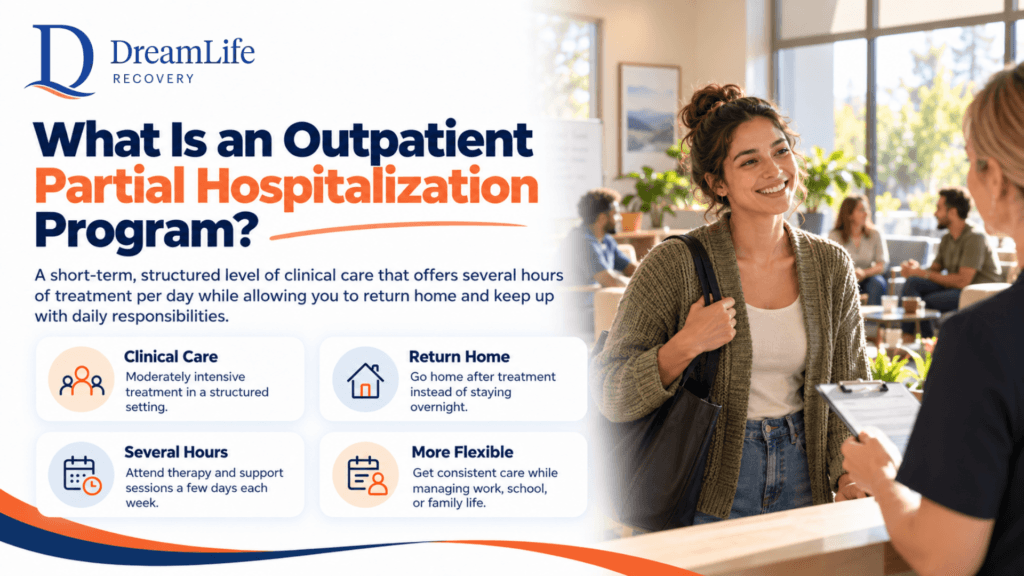
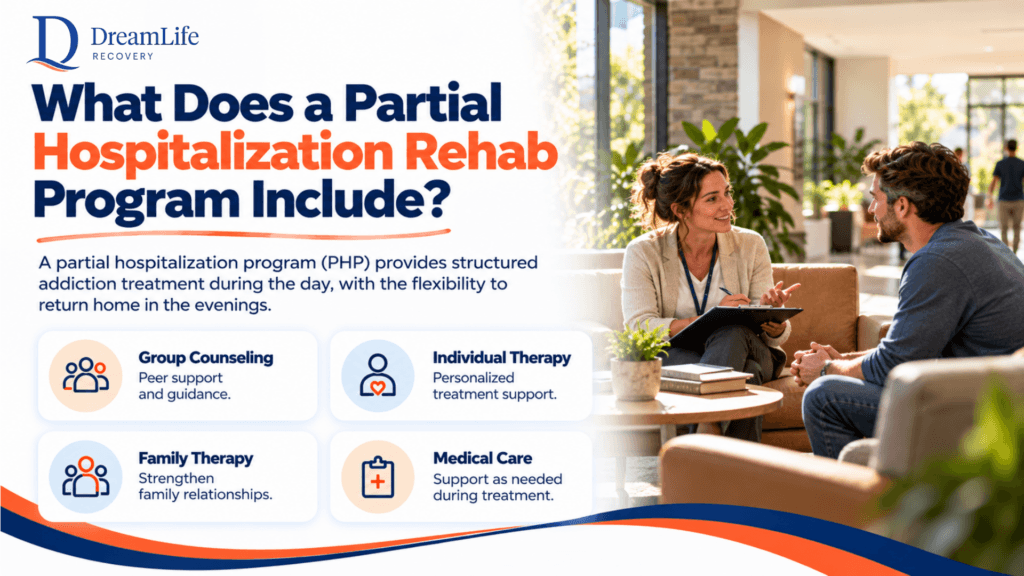
A partial hospitalization program is structured, clinically intensive treatment delivered during the day, with clients returning home or to sober living at night. It sits between residential treatment and standard outpatient therapy, providing close to the intensity of inpatient care without the overnight stay. DreamLife Recovery’s PHP includes individual and group counseling, family therapy and access to on-site medical staff when needed.
2. How many hours a week is PHP?
PHP at DreamLife Recovery typically runs three to five days per week, around six hours per day. That intensity is what distinguishes it from standard outpatient therapy and makes it suitable as the next step after residential treatment. The exact schedule is set during assessment based on clinical need.
3. Do you live at the facility during PHP?
No. PHP is not residential, so clients return home or to a home-like sober living setting each evening and come back the following day. That arrangement makes it workable for people with childcare or household responsibilities who cannot be away overnight, while still providing daily clinical structure.
4. How is PHP different from inpatient treatment?
Inpatient or residential treatment means living at the facility full time with 24-hour supervision and complete separation from the outside environment. PHP provides a comparable level of daily clinical care but allows a person to go home each evening, which offers more flexibility and begins the process of applying recovery skills in real life. Residential remains the better option for anyone who needs to be removed entirely from an unstable environment.
5. Who is a partial hospitalization program right for?
PHP suits people stepping down from residential treatment who are not yet ready for weekly outpatient therapy, and people whose addiction needs intensive treatment but who have a stable, supportive home environment. It also works for those who need medical or psychiatric oversight during the day but not overnight. An assessment determines whether PHP is the appropriate level of care or whether residential treatment is needed first.