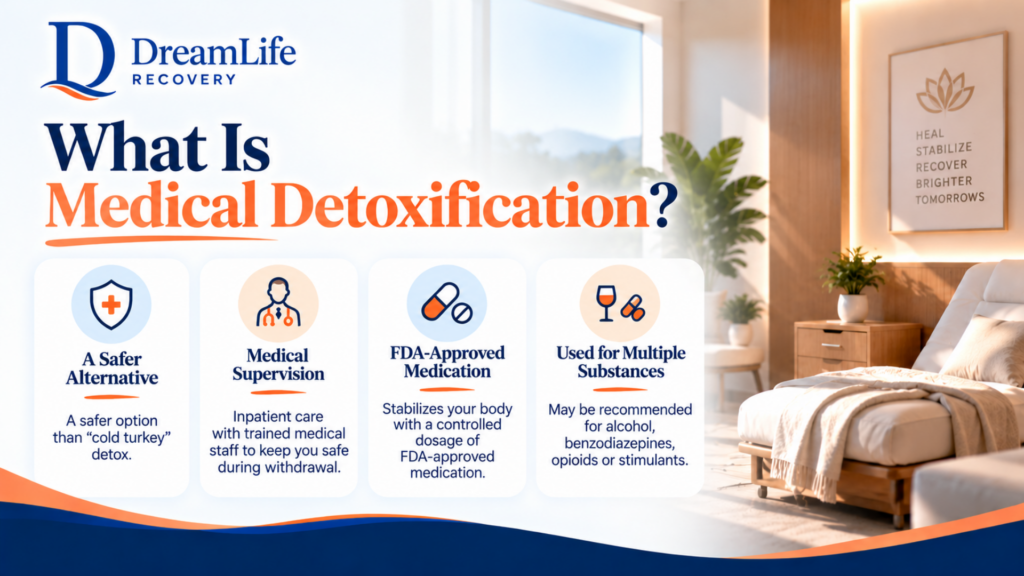
Medical detoxification is often a necessary first step for patients entering residential treatment. At DreamLife Recovery, our medical detox facility program weans patients off toxic substances through controlled medication. For many, medical detox is a life-saving procedure. This process, otherwise known as tapering, eliminates physical dependence and decreases withdrawal symptoms.

Why Do We Offer Inpatient Medical Detox?
There are many common misconceptions about drug or alcohol detoxification with medication. Some people may think that it substitutes one drug for another or that it’s an end-all-be-all for addiction treatment. Neither assumption is correct.
Medical detoxification addresses physical dependence on a substance and lays the foundation for ongoing treatment. We offer medical detox as the first step for inpatient rehab because it can:
• Reduce painful symptoms: Withdrawal symptoms can include anything from nausea to seizures. Medical detox can ease patients out of their dependence with fewer harmful symptoms.
• Decrease cravings: Detox medications block the brain’s receptors to a typical high so patients can experience fewer cravings.
• Increase treatment retention: Medical detox is step one of lifelong recovery. We see higher treatment retention rates when patients experience a more comfortable withdrawal.
• Tackle the root of addiction: The root of addiction is far deeper than physical dependence, so we use this time to address any psychological needs.
A Typical Stay at Our Inpatient Medical Detox Facility
At DreamLife Recovery, we provide effective medical detoxification near you as the first step toward recovery. As a fully accredited treatment center, we go beyond the detox process to provide complete rehabilitation. After your medical detoxification, we begin a personalized recovery program.
Here’s what you can expect from our residential treatment program post-detox:
Individualized therapy: Addressing your individual needs comes from personalized treatment. You can meet with any of our therapists for one-on-one, judgment-free discussions.
• Group support: Part of residential recovery is having access to a group of people in similar situations. Group counseling sessions can help remind you that you are not alone in your sobriety journey.
• Building amenities: Our treatment facility is well-equipped with everything you need to feel comfortable. Enjoy amenities like a private bedroom, gym and yoga classes.
• Aftercare planning: We offer the support you need to stay true to your sobriety goals. We know it’s not an easy task, so we provide aftercare planning sessions and alumni resources.
Choose DreamLife Recovery for Expert-Assisted Medical Detoxification
Addiction treatment and recovery are challenging, so we aim to make it as comfortable as possible. At DreamLife Recovery, sobriety is not a box you can check off your to-do list; it is a process. With our medical detox rehab services in your area, you can take the first step toward lifelong sobriety.
We want you to access quality, professional treatment regardless of the cost. Talk with our admissions team or your insurance provider to learn more about our in-network coverage. If you are interested in starting medical detoxification, we accept admissions 24/7/365. Call us at (844) 402-3592 or connect with us online to get the help you deserve.
Get Your DreamLife
Recovery from alcohol and drug addiction is possible, for you or a loved one. We’re here to help.
Frequently Asked Questions
1. What is medical detoxification?
Medical detoxification is a supervised, medication-based process that tapers a person off a substance while clinical staff manage the physical symptoms of withdrawal. Rather than stopping abruptly, the body is brought down gradually under medical oversight, which reduces both the severity and the danger of withdrawal. For people dependent on alcohol, benzodiazepines or opioids, it can be a life-saving procedure.
2. How is medical detox different from detoxing on your own?
Detoxing alone means facing withdrawal with no monitoring, no medication and no way to respond if something goes wrong. Medical detox provides access to 24-hour care, medication administered only by licensed staff, and immediate intervention if complications such as seizures, dehydration or cardiac problems develop. It also removes the access to substances that makes home detox fail so often, and leads straight into treatment instead of ending at the front door.
3. What medications are used in medical detox?
The medications depend on the substance involved. For opioid dependence, DreamLife Recovery may use methadone, buprenorphine or naltrexone to control withdrawal and cravings. For alcohol dependence, acamprosate is among the medications used to support stabilization and reduce craving. All medications are prescribed after a medical assessment and administered by licensed staff.
4. Who needs medically supervised detox?
Anyone physically dependent on alcohol or benzodiazepines should detox under medical supervision, because withdrawal from these can cause seizures and can be fatal. It is also strongly recommended for opioid dependence, for anyone using more than one substance, for people with a medical condition such as heart disease or diabetes, and for anyone with a co-occurring mental health condition. A medical assessment at intake determines the right level of care.
5. How long does medical detox take?
Medical detox typically lasts from a few days to a few weeks, depending on the substance, the dose, how long it was used and the person’s overall health. Opioid detox commonly runs about five to seven days, while a benzodiazepine taper can take considerably longer because it has to be reduced gradually. DreamLife Recovery accepts admissions 24/7/365, and the medical team sets the timeline individually after assessment.